Oona: the water the mountain couldn't return cold
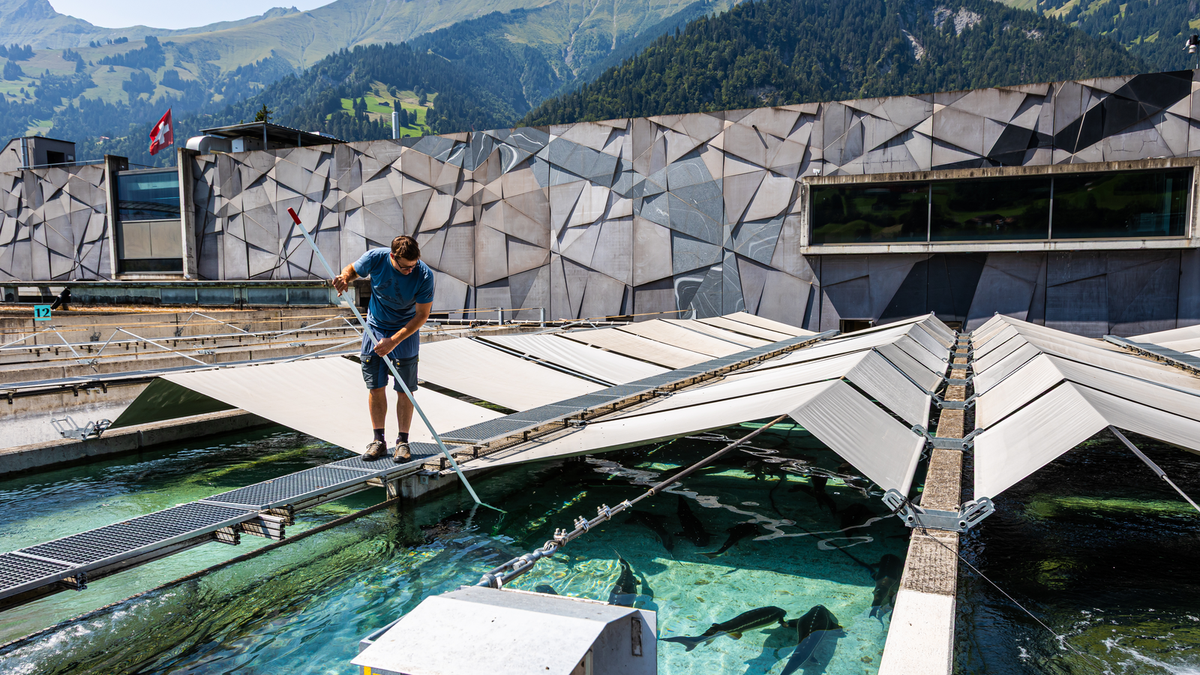
In 1994, while the Lötschberg base tunnel was being dug, the drills struck a spring nobody had expected: water at 20 degrees, pouring without pause from the pierced mountain at Frutigen, in the Bernese Oberland. At first it was a problem. That warm water could not be released into the river Kander: it would have changed its temperature and disturbed the biological rhythm of the trout that live there — a species Swiss law protects strictly. Instead of cooling it artificially, someone had a different idea: to use it to warm something.
Within a decade, that something became a greenhouse that today produces sturgeon and caviar at 800 metres above sea level, in an Alpine valley where neither should exist. The first entirely Swiss caviar — not imported, not processed elsewhere, but born, raised and harvested in that same water — reached the market in 2011. Today the brand is called Oona.
It is a story that shows well what it means for a producer to have no shortcuts: sturgeon grow slowly, and the quality of their roe improves with the age of the fish. In the early years Oona processed every fish that carried roe, following the most immediate logic — more fish processed, more caviar. Then production changed: today the sturgeon are selected at their second or third maturation cycle, not the first. Part of the yield is given up to leave the roe time to become what it can be. It is a decision that costs in volume, and one most producers would not take without a commercial reason to push them. Here the reason is simply that slower caviar is better, and worth waiting for.
The same logic shows in the details that usually stay hidden behind a label. Oona’s caviar contains no borax or other preservatives — a choice that demands tighter controls along the whole chain — and the salting is kept to the minimum needed, never above 3.5–4%, just enough to preserve without masking the taste of the roe. Within the same production there are also different degrees of rarity: the finest selection, called N°101, requires grains at least 2.6 millimetres across, a threshold reached by only about 5% of the total harvest. It is not a figure designed to sell: it is simply how little of an already scarce product meets the highest standard the company has set for itself.
It is the same criterion Sapori.world uses to decide who goes into its catalogue, caviar or not: not the biggest or cheapest supplier, but the one who has already decided, on their own, to refuse compromises nobody would have asked them to avoid. It is a choice that costs the seller too — a smaller catalogue, prices that reflect real work rather than industrial volume — but it is the only way for what is told to truly match what is sold. Oona was not chosen because its caviar is rare: it was chosen because that rarity is the direct consequence of a way of working that Sapori.world recognises and wants to support, not the result of a scarcity suffered or built for marketing. It is also, before it is a story, the promise Sapori.world makes to those who produce this way: to tell it as it really is, with no need to make it bigger.
The water from the tunnel still flows, today as in 1994, towards the same tanks. The sturgeon swimming in them do not know they owe their home to a rule imposed to protect trout in a river a few hundred metres below. This is how the best things sometimes begin: not from a plan, but from a limit taken seriously.
To discover
The Oona Caviar products selected by Sapori.world are coming soon to the catalogue.