Sake and umami: four encounters at the table
A sake never arrives at the table alone. It comes with a story of fermentation — weeks, sometimes months, in which the rice slowly yields its sugars to a yeast that, as it dies, leaves something in the liquid more important than people think: free amino acids, among them glutamate, the main source of the sensation we call umami. The slower and colder the fermentation, the more yeast cells break down over time, and the more umami stays in the glass.
This, more than any floral or fruity note, is why sake converses with Western cooking in a way wine rarely manages. Glutamate on its own is already savoury. But when it meets another molecule of the same family — guanylate in mushrooms, inosinate in fish — it produces a synergy that multiplies the perception of savouriness far beyond the sum of the parts: the same chemistry that makes Japanese dashi, kombu and katsuobushi together, so much more intense than either ingredient on its own.
It is on this chemistry, and not on an aesthetic hunch, that Cristina Volpi — Advanced Sake Sommelier and SSA Sake Educator at Kitsune Trading in Mendrisio — built four pairings for the four sakes now arriving on the Sapori.world table.
Four sakes, four pairings
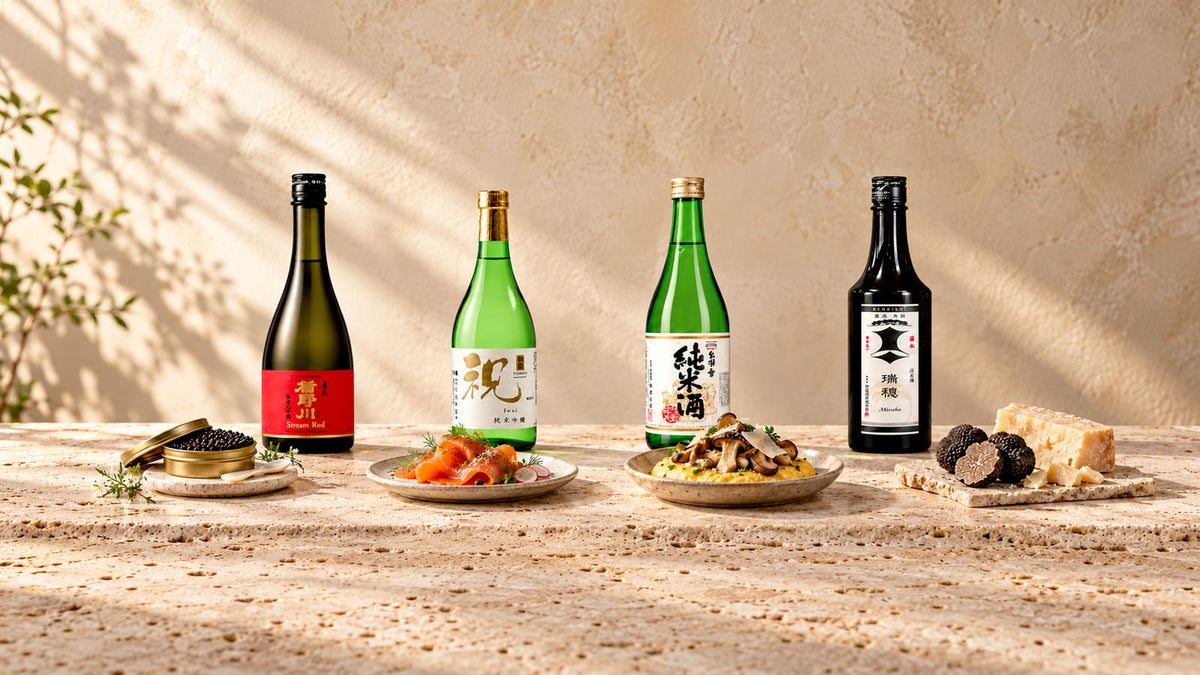
Each bottle is shown next to its pairing.


1. The smoothest sake, the quietest caviar
Tatenokawa Kyuryu is a junmai daiginjo, the category that demands the most extreme polishing of the rice grain: here only 33% of the original grain remains. The reason is not technical vanity. The outer layers of the rice hold the fats and proteins that produce the heaviest flavours during fermentation; removing almost all of them leaves a sake of great aromatic purity, with umami that is present but never intrusive. Beside caviar — already rich in savouriness of its own — it does not compete: it lets the synergy of amino acids show without covering the nuances.
2. An old rice variety, salmon touched by smoke
Tomio Iwai is made from an almost forgotten rice variety, revived and grown organically. Its profile is round, with fruity notes that balance the rich, smoky side of wild salmon without chasing it: two soft intensities that meet halfway instead of clashing.
3. The slowest method, polenta and mushrooms
Dewanoyuki is a junmai kimoto, made with the oldest and slowest way of starting a sake fermentation: a month of manual work in which the lactic bacteria naturally present in the environment — not ones added industrially, as in the sokujo method that dominates today — build up on their own the acidity that protects the mash. Today kimoto accounts for only about 2% of Japanese sake production: it has survived because it gives a structure richer in peptides, and so a body and depth the fast method does not reach. It is this richness that meets, in polenta, mushrooms and cheese, another natural source of guanylate and structured savouriness: the same synergy as dashi, translated here into the flavours of the Ticino table.
4. Time that concentrates, aged cheese and truffle
Kenbishi Mizuho is a koshu, an aged sake — in this case for up to eight years. As it ages, water slowly evaporates and chemical reactions keep working in the liquid, concentrating precisely the amino acids that give body and umami: the same principle, on a different timescale, that makes an aged cheese more intense than a fresh one, or gives truffle a density of aromas no young ingredient has. Two slow fermentations, two different times, that in the end speak to each other.
One table, two traditions
These are not four Japanese bottles added to a European catalogue. They are four demonstrations that umami has no passport: it appears wherever fermentation has time to work, in rice as in milk or the forest floor. The expertise of the person who chose them lies precisely here — in having seen, behind each label, the chemistry that lets two distant cuisines sit at the same table.
To discover
Tatenokawa Kyuryu 33% – Junmai Daiginjo · Tomio Iwai – organic Junmai Ginjo · Dewanoyuki Kimoto – Junmai · Kenbishi Mizuho – aged Junmai (Koshu) · Tasting set – all 4 bottles together, selected by Kitsune Trading for Sapori.world.